
Engine sounds by engine type
Why does a V12 scream, a cross-plane V8 burble and a rotary go "brap"? Pick an engine layout to hear every car we have with it and to see how cylinder count, firing order and exhaust design shape the sound.
A V12 engine sound is the smoothest and highest-pitched of the common piston layouts because it fires six times per revolution, every 60 degrees, so the power pulses blend into one continuous tone.
V101 carA V10 engine sound is higher and more urgent than a V8 at the same rpm because it fires five times per crankshaft revolution instead of four, and the best road-car V10s rev past 8,000 rpm on top of that.
V811 carsA V8 engine sound is either a lumpy, off-beat burble or a smooth, high-pitched wail, and which one you get depends mostly on the crankshaft.
Flat-61 carA flat-6 sound is a hard, metallic howl rather than a rumble: six horizontally opposed cylinders fire at even 120-degree intervals, so it is as smooth as an inline-six, while its mechanical noise and intake tuning give it a rasp of its own.
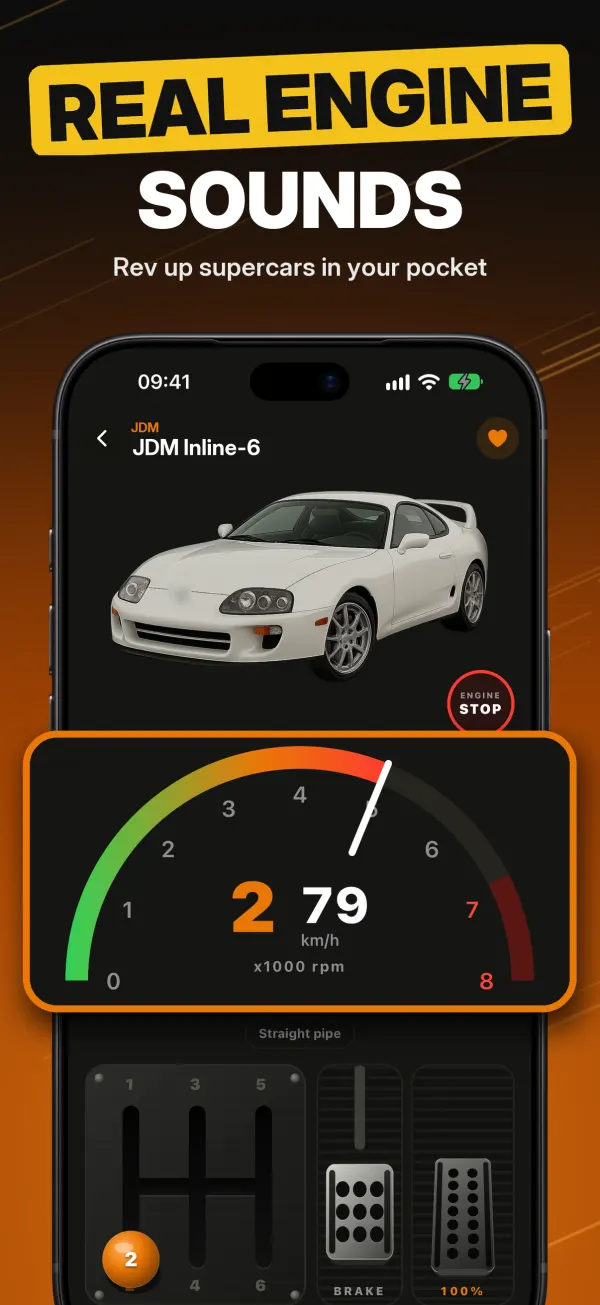
Inline-63 carsAn inline-6 sound is smooth, even and silky, with a turbine-like rise in turbocharged versions, because six cylinders in a row are perfectly balanced and fire at exactly even 120-degree intervals.
V61 carA V6 engine sound is usually raspy and a little hollow: it fires three times per revolution, fewer pulses than a V8, so each one stands out more, and even-firing V6s have a snarl rather than a burble.
Rotary1 carA rotary engine sound is a raspy, high-pitched buzz at speed and a choppy 'brap' at idle because a Wankel fires once per eccentric-shaft revolution for every rotor, through exhaust ports that open abruptly with no valves in the way.
Boxer-41 carThe boxer engine sound most people know is the Subaru rumble, a lumpy, off-beat burble that comes not from the boxer layout itself but from unequal-length exhaust headers that make the exhaust pulses arrive unevenly.
Inline-43 carsAn inline-4 sound is thin and buzzy compared with bigger engines because it fires only twice per revolution, so its pulses are widely spaced, and an uncancelled vibration adds a coarse edge.