

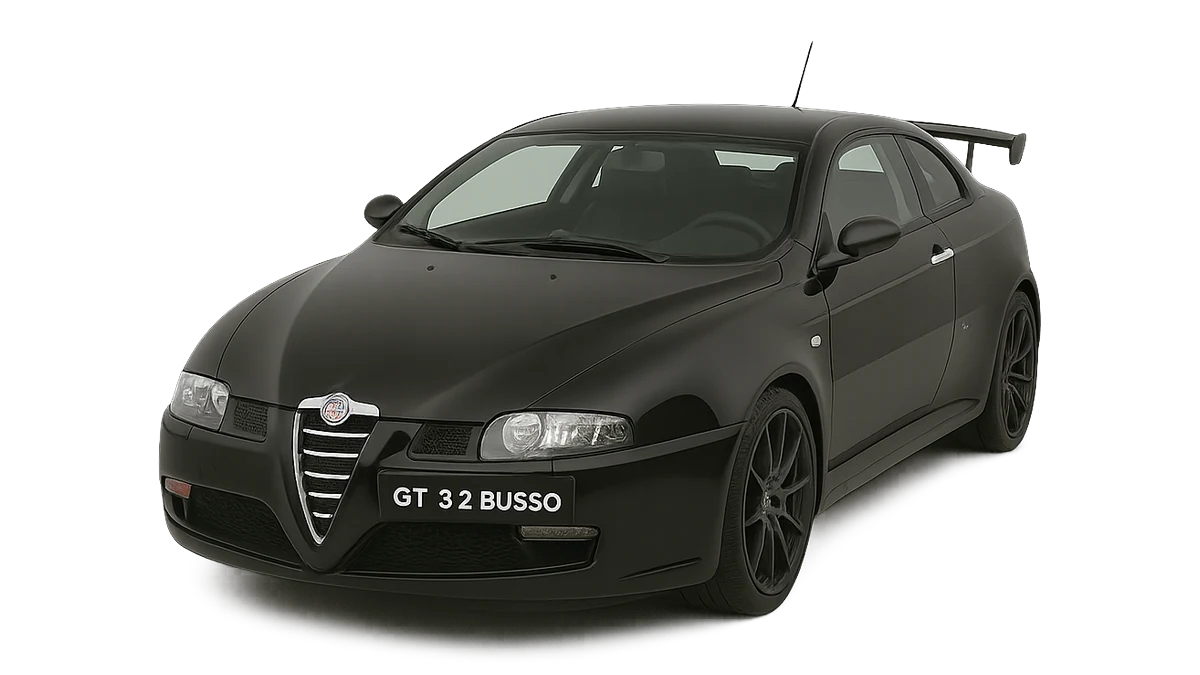
V6
A V6 engine sound is usually raspy and a little hollow: it fires three times per revolution, fewer pulses than a V8, so each one stands out more, and even-firing V6s have a snarl rather than a burble. The Alfa Romeo Busso V6 is the classic proof that a V6 can sound as good as many V8s.
A four-stroke engine fires half its cylinders per crank revolution, so a V6 fires three times per turn. The firing frequency is rpm / 60 × 3: 340 Hz at 6,800 rpm, exactly the same as an inline-six at that speed and lower than a V8's 453 Hz. The firing frequency shown on each car page uses this formula.
With fewer pulses per revolution there is more of a gap between them, so a V6 sounds less dense than a V8 or V12. That sparseness is where the rasp comes from: the individual pulses are easier to hear.
For even firing a V6 needs a power stroke every 120 degrees. A 60-degree V6 with six separate crankpins does this naturally. Each bank then works like an inline-three firing every 240 degrees, and each bank's exhaust gets an even but widely spaced train of pulses, which gives the characteristic hard, slightly hollow edge.
90-degree V6s were often built on V8 tooling, and some early ones shared crankpins and fired at uneven intervals, giving a rough, lumpy note. Later versions used split crankpins to fire evenly. Bank angle, crank design and exhaust layout together decide whether a V6 sounds smooth, raspy or lumpy.
The Busso V6, named after engineer Giuseppe Busso, is a 60-degree, even-firing V6 that Alfa Romeo built from 1979 to 2005. Its polished intake runners became an icon of their own. The 3.2-liter 24-valve version in the Alfa Romeo GT is its largest form, with about 240 hp.
Naturally aspirated and eager to rev, it builds from a smooth idle to a metallic, rising howl near its redline, with plenty of intake noise mixed in. Many enthusiasts rank it among the best-sounding V6s ever made.
Most modern performance V6s are twin-turbocharged, from the Nissan GT-R to Ford's EcoBoost engines and the Formula 1 hybrid V6s used since 2014. The turbines absorb much of the exhaust pulse energy, so these engines sound deeper and more muted than naturally aspirated V6s. Their character comes more from turbo whoosh, intake noise and valved exhausts.
| Car | Engine | Redline | Hz at redline |
|---|---|---|---|
| Alfa Romeo GT (Busso V6) | 3.2 L, Naturally aspirated | ≈ 6,800 rpm | ≈ 340 |
A V6 fires three times per revolution instead of four, and even-firing V6s have no cross-plane burble. The result is a raspier, thinner note than a typical V8.
It is a matter of taste, but the Alfa Romeo Busso V6 is the most common answer: a naturally aspirated, even-firing 60-degree V6 with a sharp, rising howl.
They share the same firing frequency, but an inline-six's exhaust is usually grouped so each half receives perfectly spaced pulses, which makes it smoother. A V6 tends to sound raspier.
This sound is in the app