

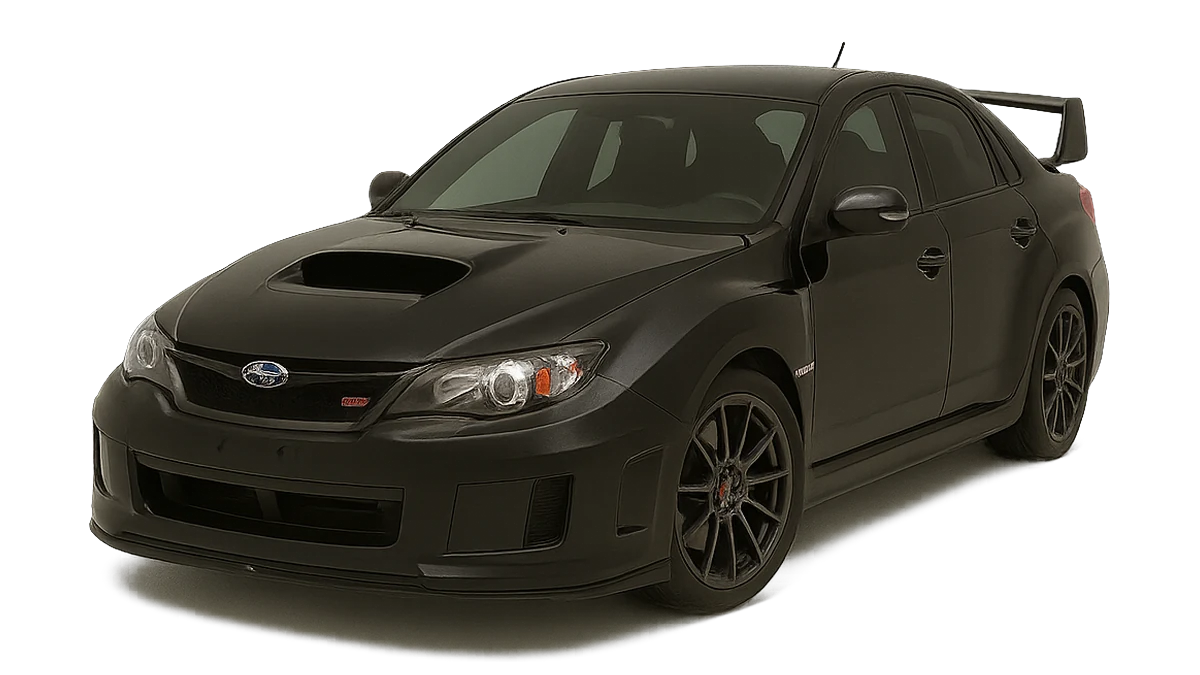
Boxer-4 · turbocharged
The boxer engine sound most people know is the Subaru rumble, a lumpy, off-beat burble that comes not from the boxer layout itself but from unequal-length exhaust headers that make the exhaust pulses arrive unevenly. The flat-four fires at perfectly even intervals; the plumbing is what makes it sound uneven.
In a boxer engine the cylinders lie flat on either side of the crank, and opposing pistons move in and out at the same time, like a boxer's fists. That cancels the primary shaking forces. A four-stroke engine fires half its cylinders per revolution, so a flat-four fires twice per turn, every 180 degrees, in the order 1-3-2-4.
The firing frequency is rpm / 60 × 2, or 233 Hz at 7,000 rpm, the same as an inline-four. The firing frequency shown on each car page uses the same formula. On frequency alone, a boxer-four and an inline-four are identical; the difference is in what happens downstream.
On Subaru's older EJ-series turbo engines, the exhaust runners from the two cylinder banks have to wrap around the engine to meet before the turbo, and they are not the same length. A pulse from a cylinder with a short runner reaches the collector sooner than one from a cylinder with a long runner. So although the cylinders fire every 180 degrees, the pulses arrive bunched: two close together, then a longer gap.
That uneven arrival pattern repeats every two revolutions and adds low-frequency content below the firing frequency. The ear hears it as a lope, the same basic effect that gives a cross-plane V8 its burble. It is most obvious at idle and low rpm, before the turbo is working hard.
Equal-length headers give every runner the same length, so the pulses arrive evenly spaced and the rumble mostly disappears. The engine sounds smoother and more like an inline-four, and with a twin-scroll turbo the evenly timed pulses also help it spool. Subaru's later FA-series turbo engines use equal-length layouts, which is a big part of why a current WRX sounds smoother than an older STI.
Plenty of owners deliberately keep or fit unequal-length headers to preserve the rumble, even though equal-length headers generally perform better.
The Impreza WRX STI's EJ-series turbocharged flat-four is the textbook rumble engine: a lumpy, off-beat idle, a gravelly burble when cruising, and a smoother, turbo-damped rush at full boost, often with blow-off valve chatter on lift.
| Car | Engine | Redline | Hz at redline |
|---|---|---|---|
| Subaru Impreza WRX STI | 2.5 L, Turbocharged | ≈ 6,700 rpm | ≈ 223 |
Older Subaru turbo engines use unequal-length exhaust headers, so the evenly fired pulses reach the collector at uneven intervals. That bunching creates the rumble.
No. The boxer layout fires evenly. A flat-four with equal-length headers, or a Porsche flat-six, sounds smooth. The rumble is a product of exhaust design.
Mostly, yes. They make the pulses arrive evenly, so the engine sounds smoother, and they usually improve turbo response as well.
This sound is in the app