

V10
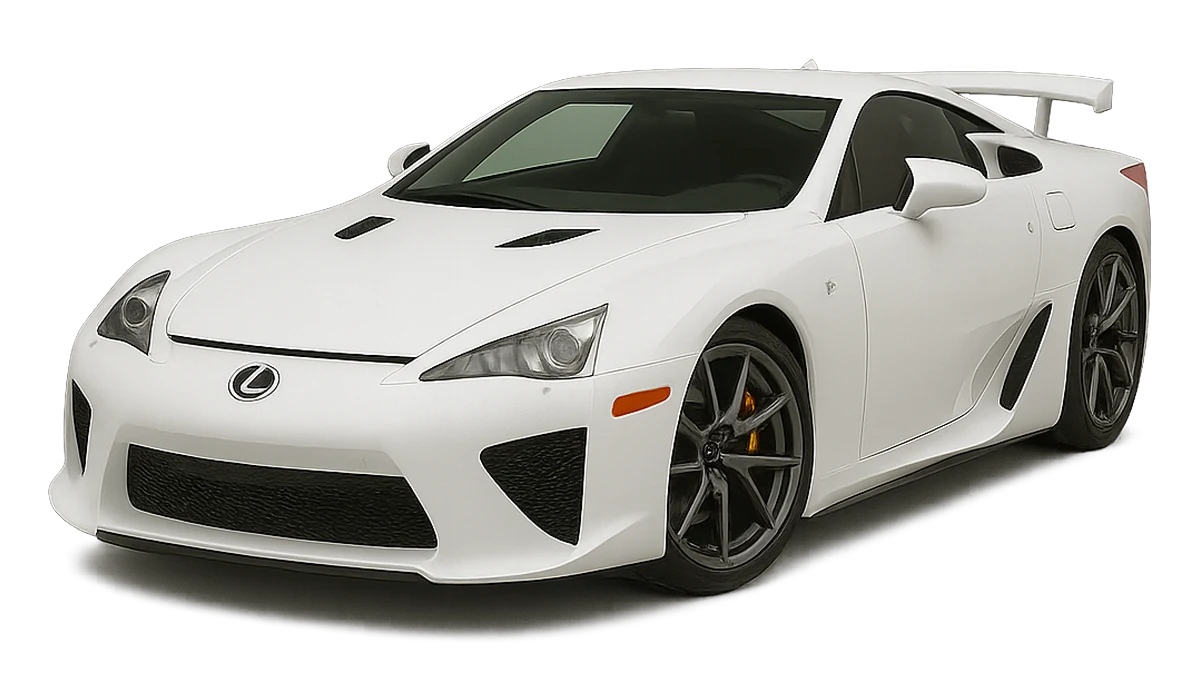
A V10 engine sound is higher and more urgent than a V8 at the same rpm because it fires five times per crankshaft revolution instead of four, and the best road-car V10s rev past 8,000 rpm on top of that. The result is the hard, metallic scream associated with the Lexus LFA, the Porsche Carrera GT and Formula 1 cars of the early 2000s.
A four-stroke engine fires half its cylinders per crank revolution, so a V10 fires five times per turn. Its firing frequency is rpm / 60 × 5. At the Lexus LFA's 9,000 rpm redline that is 750 Hz, against 600 Hz for a V8 and 900 Hz for a V12 at the same speed. The firing frequency shown on each car page is calculated the same way.
That puts the V10 between the two: more edge and urgency than a V8, a little less of the seamless, overlapping smoothness of a V12. At idle a V10 can sound surprisingly gruff; the character comes alive in the top third of the rev range.
For a V10 to fire evenly it needs a power stroke every 72 degrees, since 720 degrees of a four-stroke cycle divided by ten cylinders is 72. The LFA uses a 72-degree angle between its banks, so each bank behaves like an inline-five firing every 144 degrees. Each exhaust pipe gets a steady, evenly spaced train of pulses, and there is none of the lope of a cross-plane V8.
Many V10s use a 90-degree bank angle instead. Without split crankpins, a 90-degree V10 fires at alternating uneven intervals, which is part of why the Dodge Viper's V10 sounds more like a lumpy big-block than a race engine. With offset crankpins, a 90-degree V10 can fire evenly again.
The LFA's 4.8-liter 1LR-GUE makes 553 hp and revs to 9,000 rpm. It is widely reported to go from idle to redline in about 0.6 seconds, which is why Lexus gave it a digital tachometer: a mechanical needle could not keep up. Light internals and low rotating inertia let it change pitch almost instantly, so a blip sounds like a bark rather than a swell.
Toyota developed the engine with Yamaha, and the sound was treated as an engineering target, including how intake noise reaches the cabin. That deliberate tuning, plus even firing and a very high redline, is why many enthusiasts consider it the best-sounding road car V10.
A V10 is long, expensive and hard to make efficient. Formula 1 dropped V10s after the 2005 season, and road-car V10s have mostly been retired in favor of turbocharged or hybrid engines, which are quieter because turbos absorb exhaust energy. Recordings are increasingly the main way to hear a naturally aspirated V10 at full song.
| Car | Engine | Redline | Hz at redline |
|---|---|---|---|
| Lexus LFA | 4.8 L, Naturally aspirated | 9,000 rpm | 750 |
It is a matter of taste, but the Lexus LFA and the Porsche Carrera GT are the usual answers. Both are naturally aspirated, even-firing and rev to well over 8,000 rpm.
It shares the V10 layout of the early-2000s F1 engines, fires evenly and revs to 9,000 rpm with very little inertia. The F1 engines revved roughly twice as high, so their pitch was far higher, but the character is similar.
At idle they can be close. At high rpm an even-firing V10 is noticeably higher and smoother, with none of the off-beat burble of a cross-plane V8.
This sound is in the app