

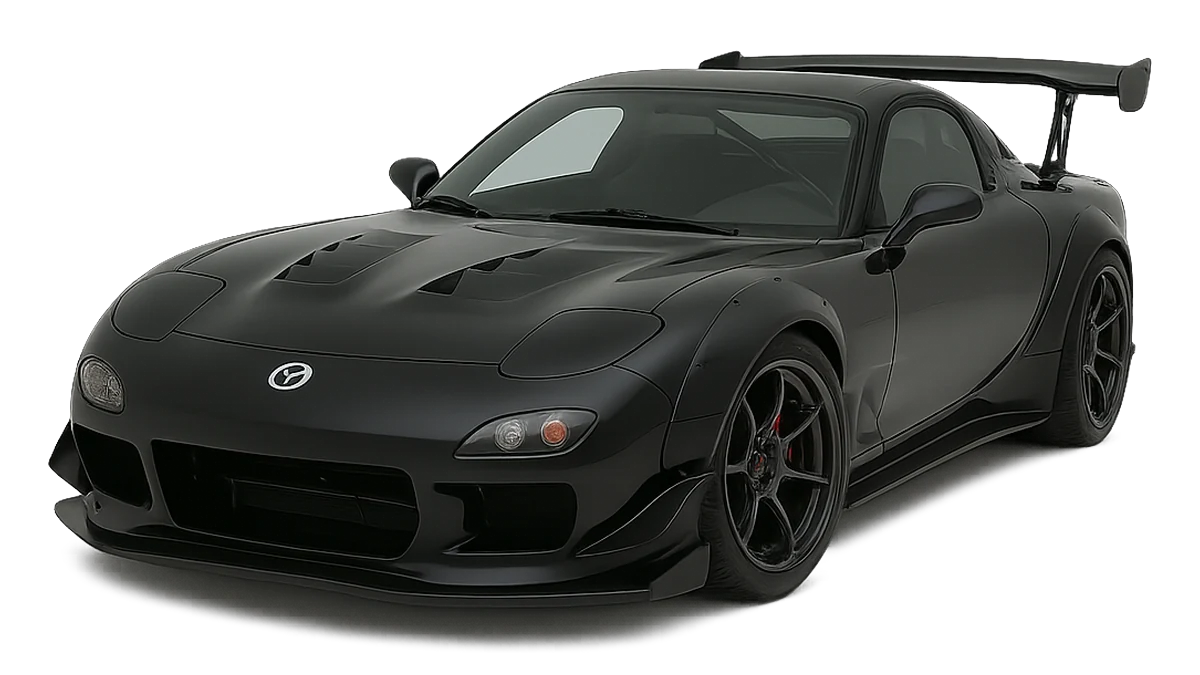
Twin-rotor Wankel · twin-turbo
A rotary engine sound is a raspy, high-pitched buzz at speed and a choppy 'brap' at idle because a Wankel fires once per eccentric-shaft revolution for every rotor, through exhaust ports that open abruptly with no valves in the way. A twin-rotor like the Mazda RX-7's 13B fires as often as a four-cylinder, but its pulses are much sharper.
A Wankel rotor is a rounded triangle spinning inside an oval-like housing. Each of its three faces completes a full intake, compression, power and exhaust cycle every time the rotor goes around, so one rotor revolution produces three power pulses. The rotor turns at one-third the speed of the eccentric shaft, so it takes three shaft revolutions to deliver those three pulses. Net result: one power pulse per shaft revolution, per rotor.
A piston cylinder in a four-stroke engine fires once every two revolutions, so one rotor fires twice as often as one cylinder. A twin-rotor 13B fires twice per revolution, exactly like an inline-four. Its firing frequency is rpm / 60 × 2, or 267 Hz at 8,000 rpm. The four-rotor Mazda 787B, which won Le Mans in 1991, fired four times per revolution, like a V8.
The difference is in the shape of each pulse. A piston engine releases exhaust through a poppet valve that eases open. The 13B's exhaust ports are peripheral ports in the housing wall, and the rotor's tip uncovers each one in a sudden sweep. Combustion gas that is still at high pressure and temperature blasts out all at once.
Each pulse is short, with a very steep leading edge. Sharp pulses are rich in high harmonics, so the ear hears a buzzy, raspy, higher-pitched sound even though the firing frequency matches a four-cylinder. With no valvetrain to limit it, a rotary also revs freely. Mazda's RX-8 engine moved its exhaust ports to the side housings, which is part of why it sounds milder than an RX-7.
The famous choppy idle mostly comes from porting. Street-ported, bridgeported and peripheral-ported rotaries have enlarged intake ports that open earlier, creating a long overlap with the exhaust. At idle, exhaust gas dilutes the incoming charge, so some faces burn strongly and others weakly or not at all. The irregular pattern is the 'brap brap'.
A stock 13B idles fairly smoothly, with a lumpy, busy hum. The more aggressive the porting, the louder and choppier the brap.
The FD Mazda RX-7, built from 1992 to 2002, uses the 13B-REW: two 654 cc rotors with sequential twin turbos. The turbos soften the exhaust somewhat, so a stock FD sounds smoother than a naturally aspirated rotary, but at high rpm the raspy, buzzing rotary character is unmistakable.
| Car | Engine | Redline | Hz at redline |
|---|---|---|---|
| Mazda RX-7 (FD) | 1.3 L, Twin-turbo | 8,000 rpm | 267 |
Mostly because of porting. Enlarged ports create long intake and exhaust overlap, so at idle some rotor faces fire weakly or misfire, giving an irregular, choppy rhythm.
Their exhaust ports open suddenly, releasing short, sharp pulses rich in high harmonics, and they rev freely. A twin-rotor fires as often as a four-cylinder, but sounds much buzzier.
No. Each rotor face runs a four-stroke cycle. But each rotor fires once per shaft revolution and uses ports instead of valves, so in rhythm it behaves a bit like a two-stroke.
This sound is in the app