

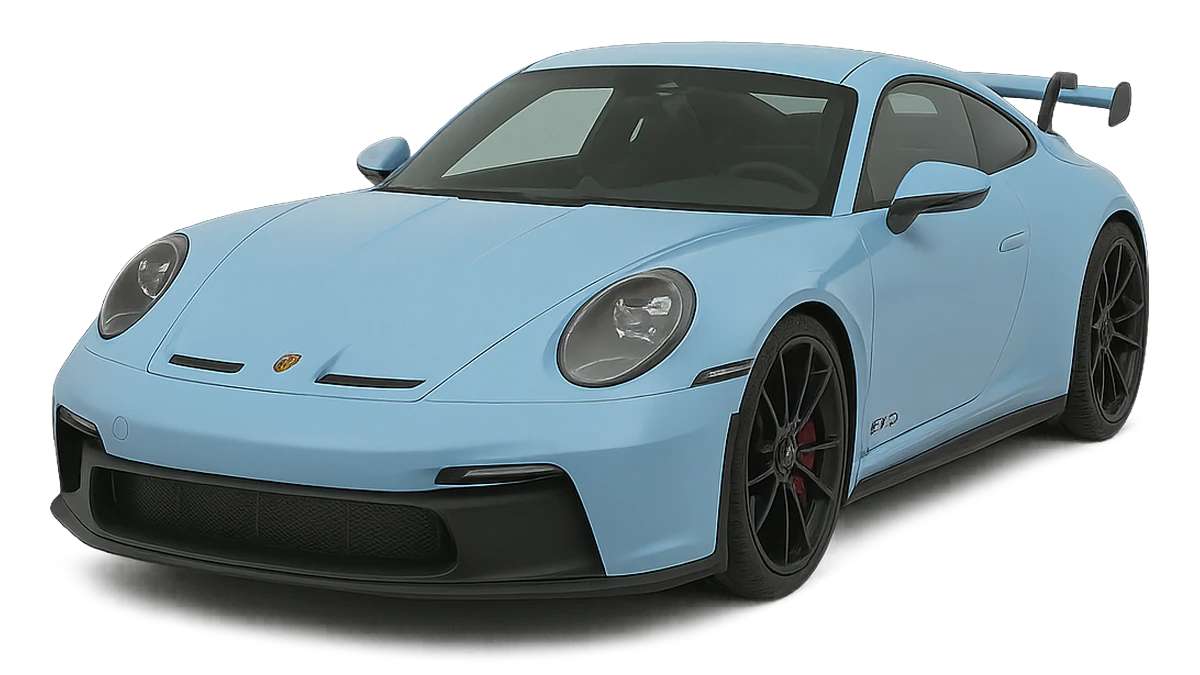
Flat-6
A flat-6 sound is a hard, metallic howl rather than a rumble: six horizontally opposed cylinders fire at even 120-degree intervals, so it is as smooth as an inline-six, while its mechanical noise and intake tuning give it a rasp of its own. Porsche's naturally aspirated 911 GT3, revving to 9,000 rpm, is its loudest expression.
A four-stroke engine fires half its cylinders per revolution, so a flat-six fires three times per turn. The firing frequency is rpm / 60 × 3, or 450 Hz at the 992 GT3's 9,000 rpm redline, a speed very few six-cylinder road engines reach. The firing frequency shown on each car page uses the same formula.
Porsche's flat-sixes are boxers: opposing pistons move in and out at the same time, so their forces cancel. Like an inline-six, a boxer-six is fully balanced, and its short, stiff crank lets it rev freely.
Porsche's firing order, 1-6-2-4-3-5, alternates between the two banks, so each bank fires every 240 degrees. Each bank's exhaust gets an evenly spaced train of pulses, and the two streams interleave into a regular one. There is nothing uneven for the ear to hear as a burble.
The Subaru boxer rumble comes from unequal-length exhaust headers on a four-cylinder, not from the boxer layout itself. A Porsche flat-six with well-matched headers sounds smooth and even, closer to an inline-six or a small V12 than to a Subaru.
The 992 GT3's naturally aspirated 4.0-liter flat-six makes 502 hp and breathes through individual throttle bodies, one per cylinder. Because the engine sits behind the passengers, a lot of what you hear inside is intake noise and mechanical sound from the valvetrain, layered over the exhaust.
The result changes character across the rev range: a busy, slightly gravelly idle, a hollow induction growl in the midrange and a sharp, metallic howl in the last few thousand rpm before the 9,000 rpm limit.
Air-cooled 911s, built until 1998, add the whir of the cooling fan and more mechanical noise, because there are no water jackets to damp it. Water-cooled engines sound cleaner. Since 2016 the regular 911 Carrera has used a twin-turbo flat-six, whose turbines absorb exhaust energy and make it deeper and quieter, which is why the naturally aspirated GT models are the ones enthusiasts seek out for sound.
| Car | Engine | Redline | Hz at redline |
|---|---|---|---|
| Porsche 911 GT3 (992) | 4.0 L, Naturally aspirated | 9,000 rpm | 450 |
A flat-six fires evenly and revs very high, and in a rear-engined 911 you hear a lot of intake and mechanical noise from right behind you. Naturally aspirated GT engines add individual throttle bodies and redlines of up to 9,000 rpm.
A boxer is a flat engine in which opposing pistons move in and out together. Porsche's flat-sixes are boxers, so in practice the terms are used interchangeably for them.
They share the same firing frequency and are both perfectly balanced, so both are smooth. A Porsche flat-six usually sounds harder and more metallic, partly because of its high redline and intake design.
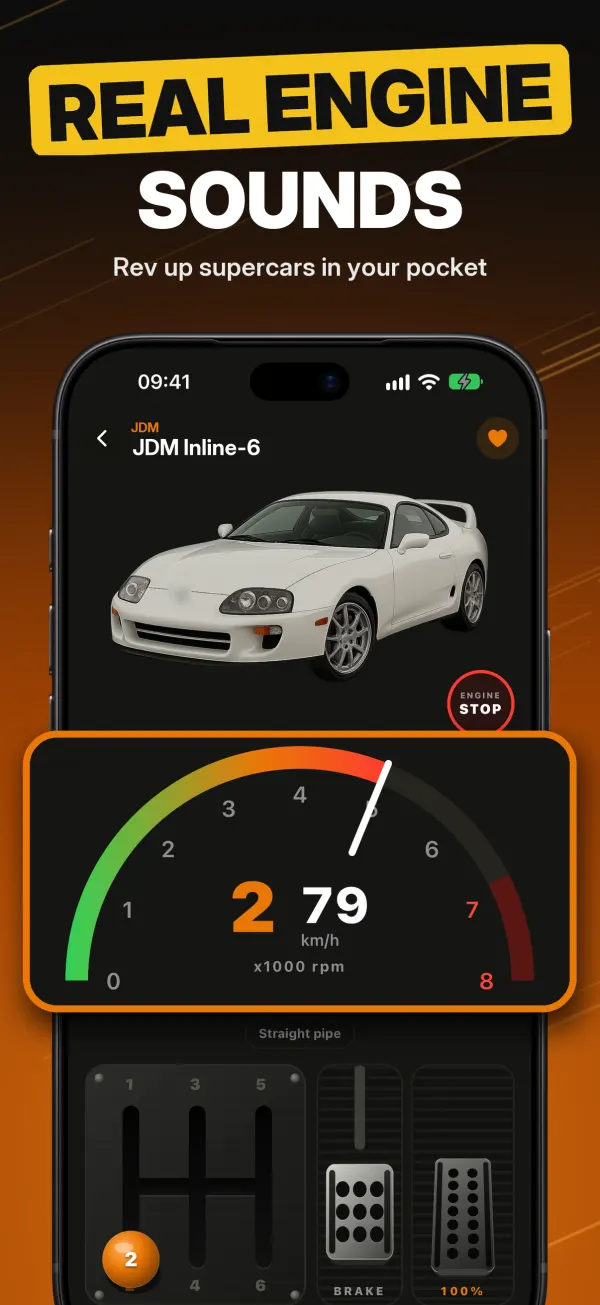
This sound is in the app