
V10
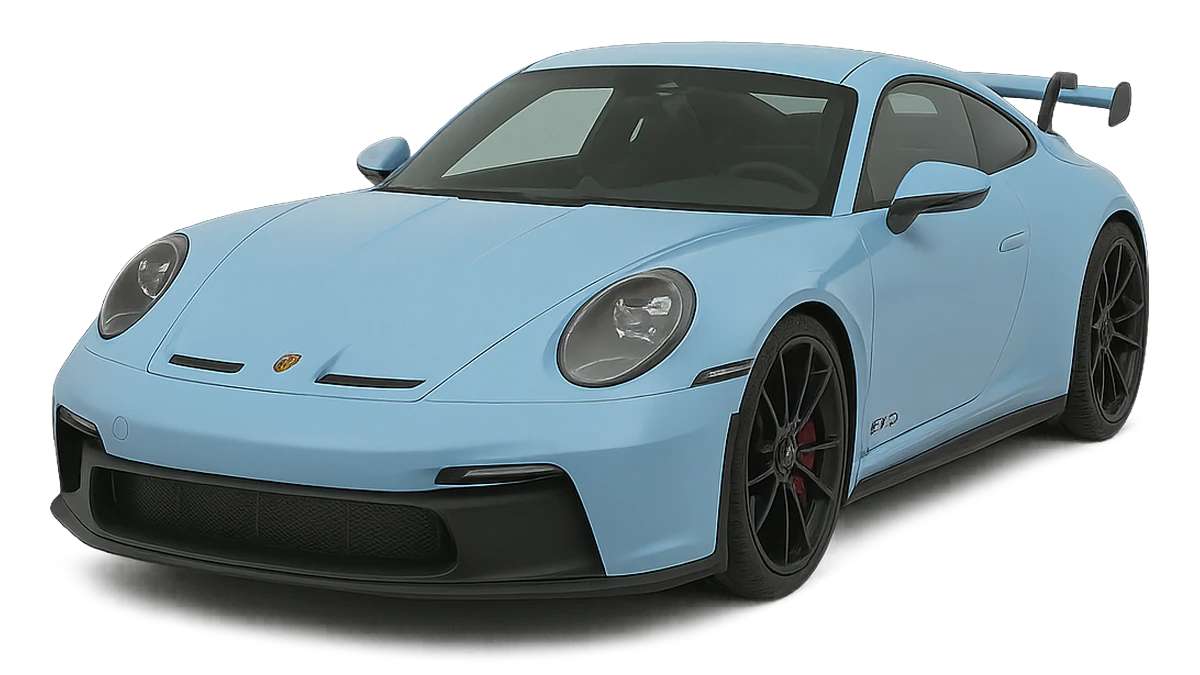
The Porsche 911 GT3 (992) sounds like a race engine with license plates: a 4.0-liter naturally aspirated flat-six that revs to 9,000 rpm, with a busy, mechanical idle and a hard, metallic rasp at the top. Because the engine sits behind the rear axle and breathes through six individual throttle bodies, you hear a lot of intake noise along with the exhaust.
A flat-six has two banks of three cylinders facing each other, and it fires three times per crank revolution, once every 120 degrees. Each bank's three cylinders also fire at even intervals, so both sides of the exhaust receive cleanly spaced pulses. That even spacing is why a flat-six sounds like a smooth, hard rasp rather than a lumpy burble.
Three firings per revolution is half the rate of a V12, so at the same rpm a flat-six has a lower, more distinct pulse. The GT3 makes up for it with revs: at 9,000 rpm it fires 450 times per second (the firing frequency shown above), and its strong upper harmonics give the note its metallic, almost shrieking edge near the limiter.
Porsche based the 992 GT3's engine on the one in its 911 GT3 R race car. It uses individual throttle bodies, one per cylinder, and dry-sump lubrication, and it makes its 502 hp (510 PS) at 8,400 rpm, just below the 9,000 rpm limiter. Individual throttles sharpen response and add a crisp, hollow intake sound, especially on quick blips.
The exhaust is valved, so it stays relatively restrained at low load and opens up as you push harder or select the sportier exhaust setting. Because the engine is behind the cabin, the driver hears a mix of intake, mechanical noise and exhaust that is different from what bystanders hear.
Turbocharged 911 Carrera models rev lower and send their exhaust through turbochargers, which absorb much of the pulse energy and flatten the sound. The GT3 skips the turbos entirely, so it keeps the high-rpm wail that older naturally aspirated 911s were known for. It is offered with a seven-speed PDK dual-clutch or a six-speed manual, and the manual adds the pauses and blips of a traditional gearchange to the soundtrack.
A 4.0-liter naturally aspirated flat-six based on the 911 GT3 R race engine. It makes 502 hp (510 PS) at 8,400 rpm and revs to 9,000 rpm.
No. The GT3 is naturally aspirated, which is why it sounds sharper and revs much higher than the turbocharged 911 Carrera models.
The 992 GT3 RS uses the same 4.0-liter engine family with a little more power, so the core sound is very similar. Differences come mostly from the exhaust, calibration and how much noise the body lets into the cabin.
This sound is in the app