
Inline-6 · twin-turbo
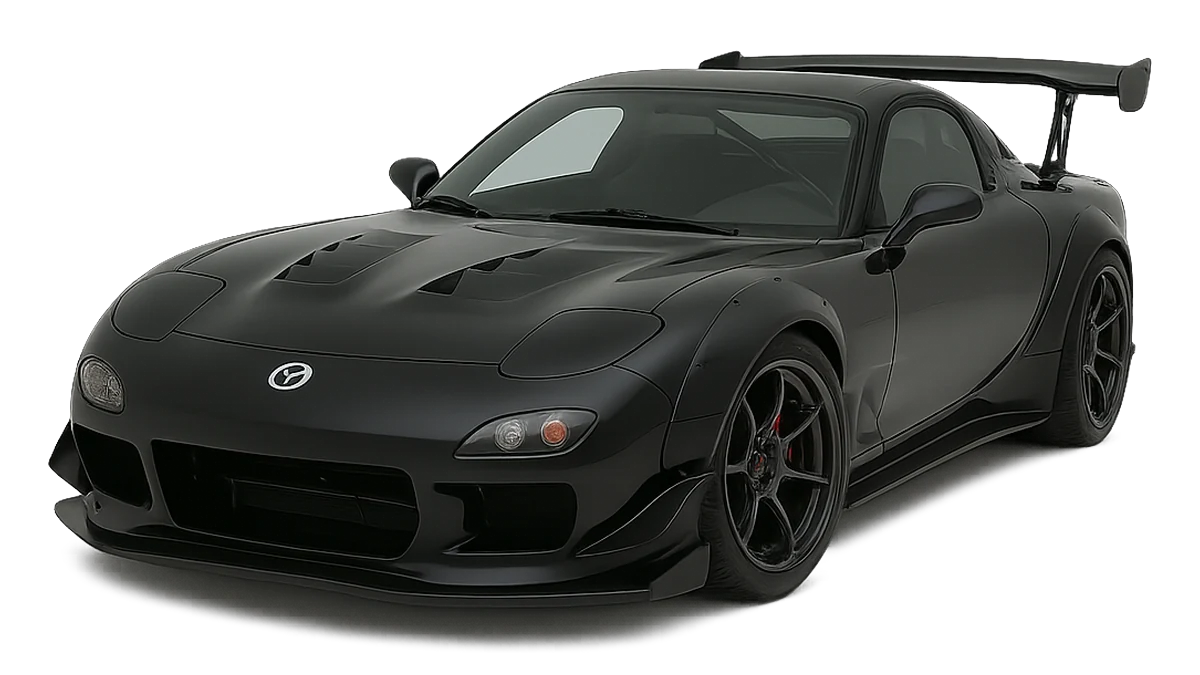
The Mazda RX-7 FD sounds like nothing with pistons: a busy, buzzing idle that turns into a smooth, rising wail near its 8,000 rpm redline, because its 13B-REW is a twin-rotor Wankel engine with no reciprocating parts and exhaust ports that release sharp, short pulses. Heavily modified rotaries add the famous choppy brap at idle, which comes from aftermarket porting rather than the factory engine.
Instead of pistons moving up and down, a Wankel engine has triangular rotors spinning inside an oval-shaped housing. Each rotor completes one combustion event per turn of the eccentric shaft, so a twin-rotor engine fires twice per shaft revolution, the same rate as a four-cylinder piston engine at the same rpm.
The tone is still completely different. There are no valves and no valvetrain clatter; the rotor simply uncovers a port in the housing, and the exhaust leaves as a sudden, high-energy pulse. Combined with the lack of reciprocating mass, that produces the rotary's smooth, buzzy, almost two-stroke-like character, and lets it rev with very little vibration.
The FD's 13B-REW has two rotors displacing 1.3 liters in total and uses two turbochargers in sequence: one works at low rpm and the second joins higher up. US-market cars sold from 1993 to 1995 were rated at 255 hp, and later Japanese-market versions were rated higher.
As with any turbo engine, the turbines take some edge off the exhaust note in stock form. A factory FD is buzzy and a little raspy rather than loud, with turbo whistle and intake rush layered over the rotary hum.
The lumpy, popping brap-brap idle that people associate with rotaries is mostly a product of modification. Enlarging or reshaping the intake ports (street, bridge or peripheral porting) increases port overlap, which makes the idle uneven and aggressive. Many FDs also run single-turbo conversions and straight-through exhausts that make them dramatically louder and sharper.
Recordings of RX-7s are often of tuned cars, so the sound you hear may be closer to a modified street car than to a stock example. Either way, the core character, smooth and high-pitched with no piston rumble, comes from the rotary design itself.
A rotary has no valves or pistons; spinning rotors uncover exhaust ports and release short, sharp pulses. That gives it a buzzy, high-pitched tone and lets it rev smoothly without the rumble of a piston engine.
Not strongly. The choppy brap idle mostly comes from ported engines with increased port overlap. A stock FD idles with a buzzier, steadier note.
The 13B-REW, a 1.3-liter twin-rotor Wankel with sequential twin turbochargers. It was the most powerful 13B fitted to a production RX-7.
This sound is in the app