
V8 · supercharged
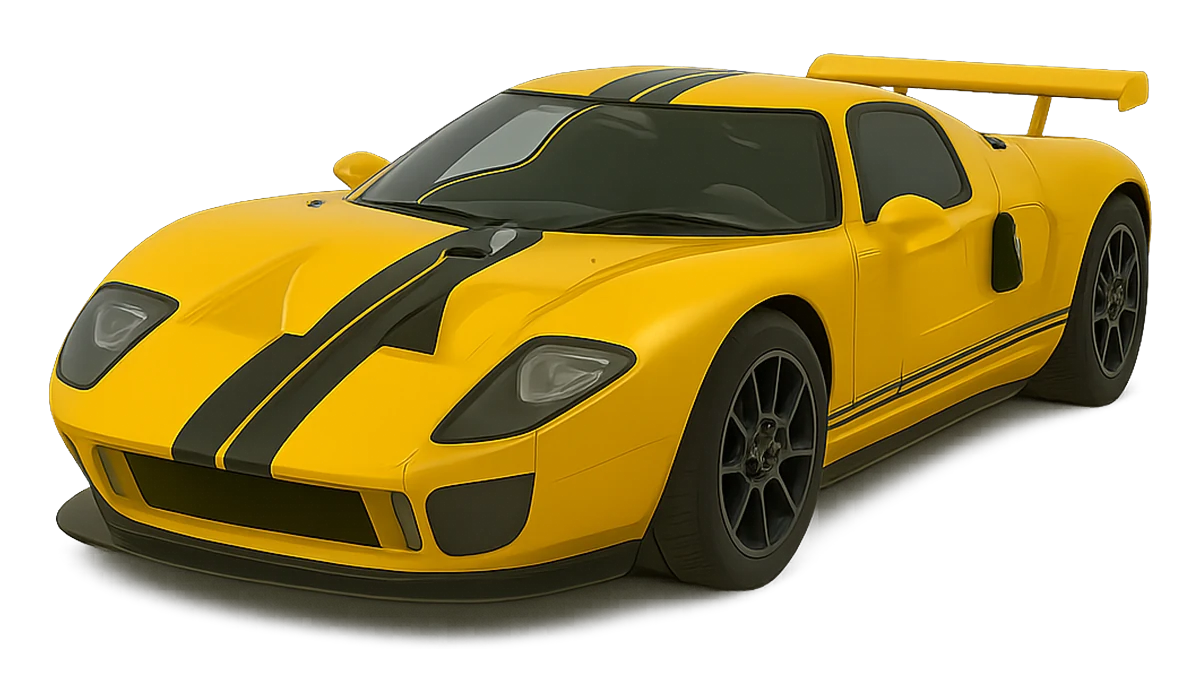
The 2005–2006 Ford GT sounds like a deep, cross-plane American V8 with a high mechanical whine layered on top, because its 5.4-liter V8 is fed by a belt-driven supercharger mounted just behind the cabin. It is a heavier, smoother and more layered sound than the 1960s GT40 that inspired it. The start, idle, rev and drive clips on this page are recordings in the Car Sounds app.
The GT's engine is a 5.4-liter, 32-valve, dual-overhead-cam version of Ford's Modular V8, rated at 550 hp and 500 lb-ft. It uses a cross-plane crank, so each cylinder bank fires at uneven intervals and the exhaust carries the familiar V8 lope at idle and low rpm. Dry-sump lubrication lets the engine sit low in the chassis, behind the seats and ahead of the rear axle.
Like any V8 it fires four times per crank revolution, so near its roughly 6,500 rpm redline it produces a little over 430 pulses per second (the firing frequency shown above). That keeps the core of the note in the bass and low midrange, closer to a muscle car than to a high-revving European V8.
The second voice is the supercharger. A twin-screw blower sits on top of the engine and is driven by a belt from the crankshaft, so its speed is tied directly to engine speed. Its meshing rotors produce a whine whose pitch rises in step with the revs, well above the exhaust note. Because the engine is right behind the driver's head, the whine is especially clear from inside the car.
Unlike a turbo, a supercharger works on the intake side and puts no turbine in the exhaust, so it does not soften the exhaust pulses the way turbos do. You get the full V8 beat from the tailpipes plus the blower on top, which is why the GT sounds busier under load than a naturally aspirated V8 of similar size.
Ford built the GT as a modern revival of the GT40, the race car that won the 24 Hours of Le Mans four years running, from 1966 to 1969. The new car borrowed the shape but is larger, standing about 44 inches tall rather than 40, and Ford sold it simply as the Ford GT.
The sound differs too. GT40s used carbureted pushrod Ford V8s, small-blocks in most cars and the 427 big-block in the Mk II and Mk IV, with racing exhausts and very little silencing, and some race cars ran 180-degree 'bundle of snakes' headers that evened out the pulses. If you came here for the Ford GT40 sound, the original is the rawer, harder-edged of the two. The 2005 GT has overhead cams, catalytic converters and road-legal mufflers, so it is deeper, smoother and more refined, with the supercharger whine as its signature. The 2017 Ford GT, with a twin-turbo 3.5-liter V6, sounds different again.
A supercharged 5.4-liter, dual-overhead-cam V8 from Ford's Modular engine family, rated at 550 hp and 500 lb-ft of torque. It drives the rear wheels through a six-speed manual transaxle.
The whine comes from the belt-driven twin-screw supercharger on top of the engine. Its rotors spin in proportion to engine speed, so the pitch rises as the revs climb.
No. The GT40 is the 1960s Le Mans race car, while the 2005–2006 Ford GT is a modern road car styled after it, with a supercharged V8 and a taller body. They sound noticeably different.
This sound is in the app