
V8
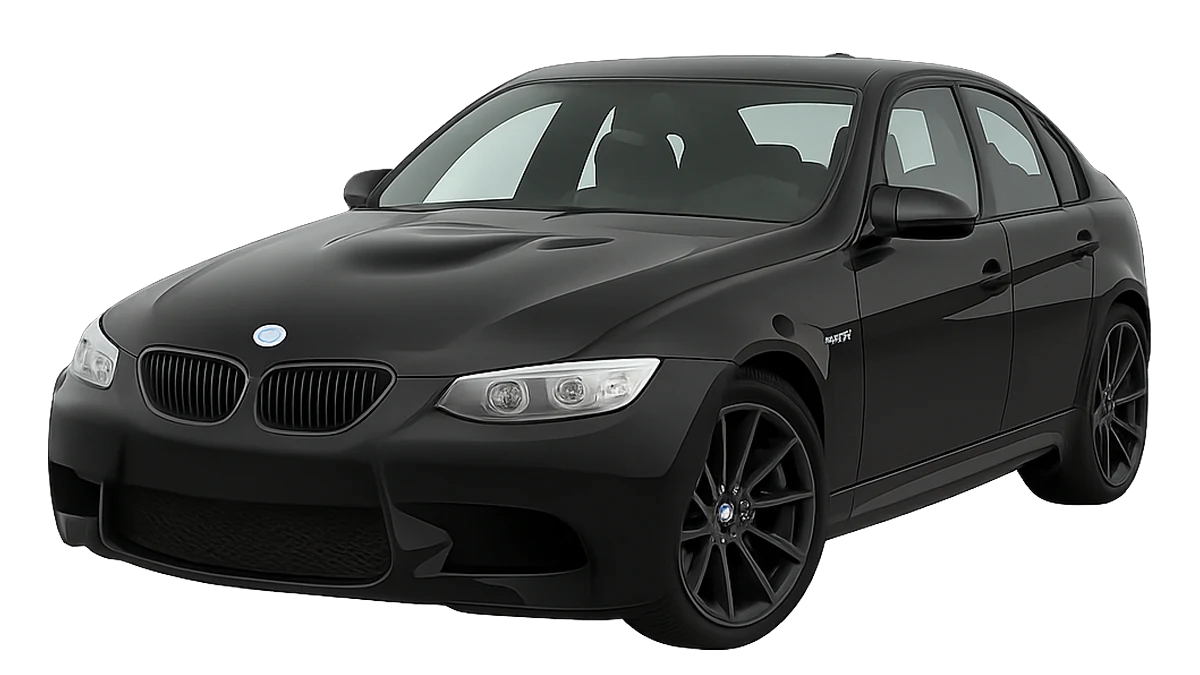
The BMW M3 E90 sounds like a race engine with manners because its 4.0-liter S65 V8 is naturally aspirated, breathes through eight individual throttle bodies and revs to 8,400 rpm. At low rpm it has the soft, uneven burble of a cross-plane V8; in the upper half of the tach the note hardens into a sharp, rising howl. The E90 is the sedan, and the E92 coupe and E93 convertible use the same engine.
The S65 is a 90-degree V8 with a cross-plane crankshaft, the layout most road V8s use. Its cylinders don't alternate evenly between the two banks, so each exhaust manifold receives pulses at uneven intervals, which is where the familiar V8 lope at idle comes from. BMW M derived the engine from the S85 V10 in the E60 M5 and kept the motorsport-style hardware: individual throttle bodies, double VANOS variable cam timing and a short-stroke design built for revs.
Peak power of 414 hp arrives at 8,300 rpm, just below the limit, so the engine is meant to be wrung out. As revs climb, the firing frequency shown above rises well past what most road V8s ever reach, and the uneven burble blends into a continuous, metallic wail. Under hard acceleration a lot of what reaches the cabin is induction noise rather than exhaust.
The E9x M3 exits through four tailpipes, and the rear muffler has a vacuum-operated flap that stays closed at low load to keep the car civil around town, then opens as revs and throttle rise. That is why a stock E90 can seem subdued at a cruise and then turn loud on a full-throttle pull. Many owners fit a flap controller to hold the valve open, which brings the louder setting to idle and part throttle as well.
The E90 sedan, E92 coupe and E93 convertible share the S65, so the engine note is effectively the same across all three; differences between recordings mostly come from modifications and microphone placement. The E9x is the only series-production M3 with a V8. The E46 M3 before it used the S54 naturally aspirated inline-six, which has a smoother, raspier tone, and the F80 that followed switched to the S55 twin-turbo inline-six, whose turbochargers take the edge off the high-rpm sound. Sitting between the two is a big part of why the E9x is so often named the best-sounding M3.
A 4.0-liter naturally aspirated V8 called the S65, rated at 414 hp. It has a cross-plane crankshaft, individual throttle bodies and an 8,400 rpm redline.
Essentially, yes. The sedan, coupe and convertible use the same S65 V8 and a very similar exhaust layout, so differences between recordings usually come from modifications, the recording setup or the position of the exhaust flap.
The usual first steps are a flap controller or a cat-back exhaust that keeps the catalytic converters in place. Removing catalysts from a street car is illegal under US federal law, and many states and cities also enforce noise limits, so check local rules before buying parts.
This sound is in the app